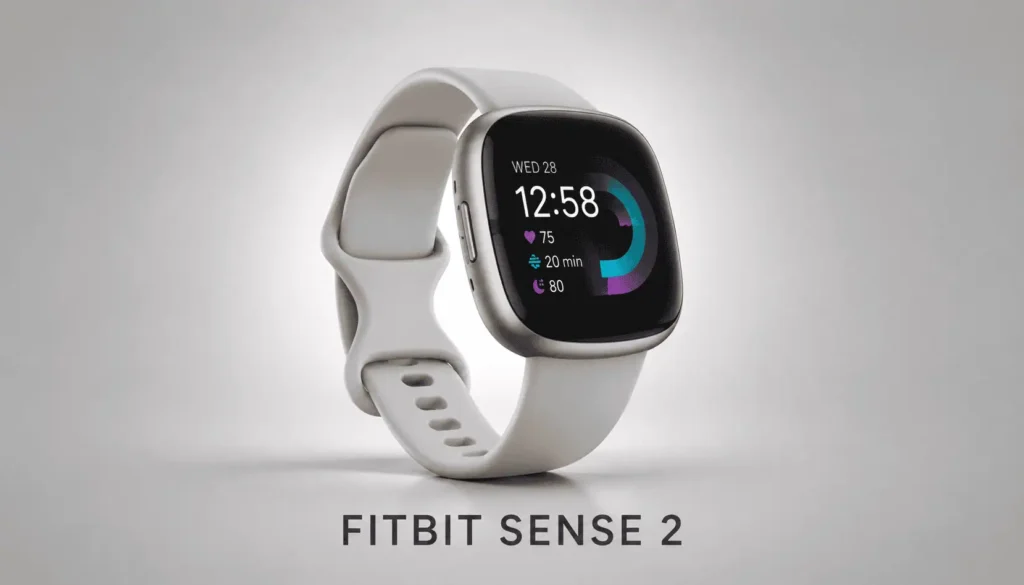
Many smartwatches compete by adding more apps, larger displays, and phone-like features. The Fitbit Sense 2 takes a more focused approach by prioritizing stress awareness, sleep tracking, heart-rate information, exercise recording, and long battery life.
Its lightweight square case makes it comfortable for all-day and overnight wear. For users who care more about wellness trends than running a miniature app store from their wrist, the Sense 2 remains an appealing health-focused smartwatch.
Quick verdict: The Fitbit Sense 2 is best for users who want detailed wellness tracking, simple fitness tools, and several days of battery life without an overly complicated interface.
The Four-Part Wellness Dashboard
The easiest way to understand the Sense 2 is to divide its features into four areas: stress, sleep, heart information, and activity.
1. Stress Awareness
The Sense 2 includes a continuous electrodermal activity sensor, commonly called cEDA. It is designed to identify possible body responses associated with stress and can prompt the wearer to reflect on how they are feeling.
Users can record their mood, complete guided breathing sessions, and review a daily Stress Management Score. Some detailed insights and guided content may require a Google Health Premium subscription.
The watch cannot determine exactly why someone feels stressed. Its real value comes from helping users notice patterns, such as whether demanding workdays, poor sleep, or intense exercise are followed by more frequent body-response notifications.
2. Sleep Tracking
The Sense 2 automatically records sleep duration and estimates time spent in light, deep, and REM sleep stages. It also provides a Sleep Score intended to summarize the previous night’s overall sleep quality.
A Smart Wake alarm can use vibration to wake the wearer during a more favorable part of the sleep cycle. Because the watch weighs approximately 37.6 grams and measures 11.2 mm thick, many users may find it comfortable enough for overnight tracking.
| Sleep feature | What it helps you review |
|---|---|
| Sleep duration | Total recorded rest |
| Sleep stages | Estimated light, deep, and REM sleep |
| Sleep Score | Simplified nightly summary |
| Smart Wake | Wrist-based vibrating alarm |
| SpO2 trends | Changes in estimated blood-oxygen data |
Sleep data should be used to observe long-term habits rather than judge one unusual night.
3. Heart and Health Information
The Sense 2 includes a multi-path optical heart-rate sensor, sensors compatible with the ECG application, red and infrared sensors for SpO2 monitoring, and a skin-temperature sensor. Availability of certain health functions varies by country and should not be considered a replacement for medical diagnosis or treatment.
The ECG app can perform an on-demand heart-rhythm assessment for possible signs of atrial fibrillation where the feature is supported. The watch can also provide high and low heart-rate alerts and irregular rhythm notifications.
These tools are designed to help users organize information they may choose to share with a healthcare professional. They should never be used to dismiss concerning symptoms or make an independent medical conclusion.
4. Daily Fitness
Built-in GPS and GLONASS allow the Sense 2 to record outdoor routes without relying entirely on a phone. It also includes an altimeter, accelerometer, gyroscope, and automatic activity-tracking tools.
The watch is suitable for walking, running, cycling, gym sessions, and general daily movement tracking. Serious endurance athletes may prefer a specialized sports watch with longer continuous GPS performance and more advanced navigation.
Battery Life: Its Practical Advantage
Google lists the Sense 2 with battery life of more than six days under suitable conditions. Continuous GPS use is rated for up to five hours, while the always-on display, SpO2 tracking, and cEDA sensor can increase charging frequency.
This endurance makes sleep tracking easier because users do not necessarily need to charge the device every night. A short charging routine every few days can keep the watch available for both daytime activity and nighttime recovery data.
Design and Durability
The Sense 2 has a 40.5 × 40.5 mm aluminum case, AMOLED display, and Corning Gorilla Glass 3. It is water resistant to 50 meters, although Fitbit recommends drying the watch and band after they become wet.
Both small and large classic bands are included. The smaller size fits wrists measuring approximately 5.1 to 7 inches, while the larger band fits wrists from about 6.5 to 8.6 inches.
Pros and Cons
Reasons to Buy
- Battery life rated beyond six days
- Comfortable for sleep tracking
- Continuous body-response monitoring
- ECG-compatible sensors
- Built-in GPS
- Detailed sleep-stage estimates
- Google Maps and Google Wallet support
- Water resistance to 50 meters
Reasons to Reconsider
- Limited continuous GPS endurance
- Smaller application selection than Wear OS watches
- Some insights require a subscription
- Gorilla Glass 3 is not as scratch-resistant as sapphire
- Health features vary by region
- Not intended for medical diagnosis
- Less suitable for advanced outdoor navigation
Final Verdict
The Fitbit Sense 2 succeeds by staying focused. It provides a clear collection of wellness tools without demanding nightly charging or overwhelming the wearer with complicated menus.
It is most valuable for users interested in sleep, stress, heart-rate trends, and everyday fitness. Buyers seeking extensive third-party apps, advanced maps, or phone-level functionality should consider a Wear OS or Apple watch instead.