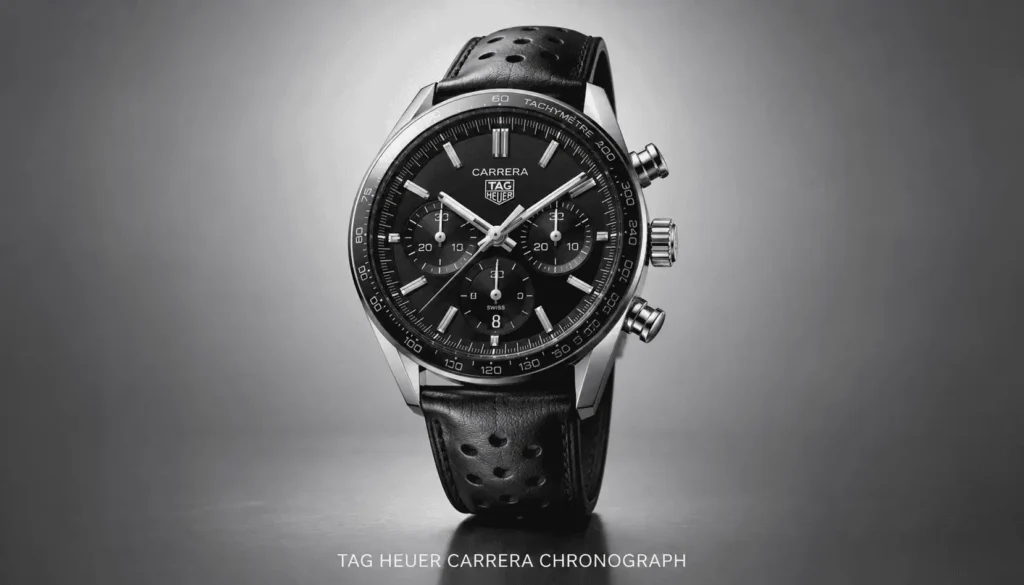
The TAG Heuer Carrera Chronograph was created around a simple objective: make elapsed time easy to read during demanding driving conditions.
That focus on visibility helped the Carrera become one of the defining racing chronographs of the twentieth century. Modern versions preserve the clean dial and motorsport identity while adding sapphire crystal, stronger water resistance, and an advanced automatic movement.
This guide focuses on the 39 mm TAG Heuer Carrera Chronograph reference CBS2210.BA0048 with a reverse-panda dial and beads-of-rice-style bracelet.
The Starting Grid: How the Carrera Began
The Carrera name was inspired by the Carrera Panamericana, a dangerous and highly competitive road race held in Mexico. Jack Heuer introduced the original Carrera chronograph in 1963.
Instead of creating an excessively decorative racing watch, Heuer emphasized legibility. The original layout used a clean dial, carefully positioned scales, and clear subdials so elapsed information could be read quickly.
The current 39 mm model draws inspiration from the historical reverse-panda Heuer reference 2447 NS. TAG Heuer combines that vintage concept with a domed sapphire “glassbox” crystal and contemporary automatic movement.
Driver’s Specification Sheet
| Feature | Carrera CBS2210.BA0048 |
|---|---|
| Case diameter | 39 mm |
| Case thickness | 13.9 mm |
| Movement | TH20-00 automatic |
| Power reserve | 80 hours |
| Frequency | 28,800 vibrations per hour |
| Water resistance | 100 meters |
| Crystal | Domed sapphire |
| Case back | Sapphire display back |
| Bracelet | Stainless steel |
| Dial | Black reverse-panda layout |
| Functions | Time, date, and chronograph |
The TH20-00 is an in-house automatic chronograph movement offering hours, minutes, seconds, a date display, a central chronograph hand, a 30-minute counter, and a 12-hour counter.
The Glassbox Design Explained
No Conventional External Bezel
The 39 mm Carrera does not use a large exterior tachymeter bezel. Instead, the scale and outer dial elements sit beneath a domed sapphire crystal.
This arrangement makes the dial appear to curve upward near the edge. It creates visual depth while keeping the overall case compact and closely connected to vintage Carrera proportions.
The Curved Flange
The flange follows the shape of the crystal and carries markings around the dial’s outer area. TAG Heuer designed the elements to support precise reading without shrinking the main hands and indexes.
The result is a dial that contains considerable information but does not feel as crowded as many modern chronographs.
Reverse-Panda Readability
A reverse-panda dial uses a dark main surface with lighter subdials. The contrast separates the chronograph counters from the normal time display.
On this model, the black circular-brushed dial is combined with contrasting subdials and applied indexes. The design feels sporty, but the polished details and moderate dimensions allow it to work with more refined clothing.
The date is integrated into the dial rather than positioned as a major visual feature. Buyers who prefer perfectly symmetrical chronographs may still wish it were omitted.
The TH20-00 Movement
The automatic TH20-00 provides an 80-hour power reserve. A fully wound watch may continue running for more than three days after it is removed, making it convenient for collectors who rotate between several watches.
The sapphire case back exposes the movement. Owners can observe the automatic rotor and finishing rather than having the mechanism hidden behind a solid cover.
Its 4 Hz operating frequency corresponds to 28,800 vibrations per hour. This supports the chronograph’s quarter-second measurement scale and the smooth visual movement expected from a modern mechanical chronograph.
Bracelet and Wrist Experience
The steel bracelet uses a beads-of-rice-inspired design with alternating polished and brushed surfaces. Its numerous smaller links provide more articulation than a simple three-link sports bracelet.
The 39 mm case offers broad wearability, although the 13.9 mm thickness gives the watch noticeable depth. The curved crystal contributes significantly to that vertical measurement.
Where It Works Best
- Business-casual offices
- Driving and motorsport events
- Weekend travel
- Restaurants and social occasions
- Casual outfits with jackets or polos
- Collectors seeking vintage proportions
Pros and Cons
Racing Advantages
- Strong connection to historic Carrera design
- Wearable 39 mm diameter
- High-contrast chronograph dial
- In-house automatic movement
- Long 80-hour power reserve
- Sapphire crystal and display back
- 100-meter water resistance
- Flexible vintage-inspired bracelet
Possible Pit Stops
- The 13.9 mm case is relatively thick
- Chronograph servicing can be expensive
- Dial is busier than a three-hand watch
- Polished bracelet links show scratches
- Date window may bother symmetry-focused buyers
- Luxury pricing places it near strong competitors
Final Verdict
The TAG Heuer Carrera Chronograph succeeds by treating racing heritage as a design principle rather than a decorative theme. Its readable dial, compact diameter, domed crystal, and high-contrast counters reflect the original Carrera’s focus on clarity.
The TH20-00 movement adds modern convenience through automatic winding and an 80-hour reserve. Meanwhile, the bracelet and sapphire case back give the watch enough refinement for daily luxury use.
For buyers seeking a chronograph with authentic motorsport roots and a modern movement, the 39 mm Carrera remains one of TAG Heuer’s most compelling models.
As an affiliate, I may earn a commission from qualifying purchases made through these links.