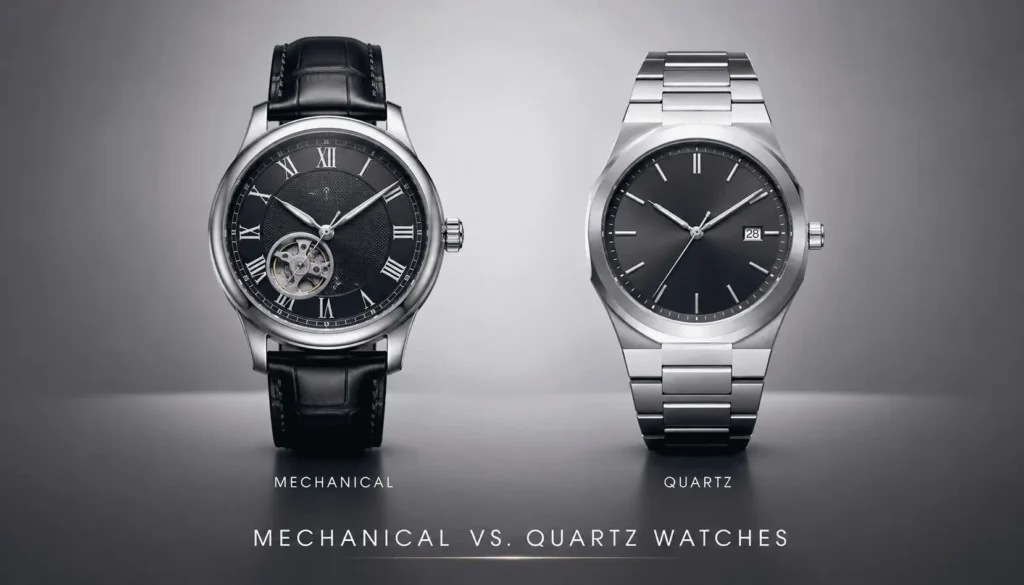
The movement is the engine inside a watch. It controls the hands, regulates timekeeping, and shapes how the owner interacts with the timepiece.
Mechanical and quartz movements can display the same hour, yet they deliver very different experiences. One emphasizes traditional engineering and physical interaction, while the other prioritizes accuracy, convenience, and low-maintenance operation.
Neither system is automatically superior. The best choice depends on what the buyer expects from a watch.
The 30-Second Explanation
A mechanical watch stores energy in a mainspring. That energy passes through gears and an escapement, while an oscillating balance wheel regulates the release.
A quartz watch normally uses a battery to send electrical energy through a quartz crystal. The crystal vibrates at a stable frequency, and an electronic circuit translates that signal into accurate timekeeping.
Simple decision: Choose mechanical for craftsmanship and interaction. Choose quartz for accuracy and convenience.
Movement Comparison Board
| Feature | Mechanical | Quartz |
|---|---|---|
| Main energy source | Wound mainspring | Battery or rechargeable cell |
| Regulation | Balance wheel and escapement | Vibrating quartz crystal |
| Typical accuracy | Measured per day | Often measured per month |
| Maintenance | Periodic mechanical servicing | Battery and gasket maintenance |
| Seconds-hand motion | Several steps per second | Commonly one step per second |
| Power interruption | Stops when reserve is empty | Runs until battery is depleted |
| Ownership style | Interactive and traditional | Practical and dependable |
| Typical cost | Often higher | Available at every price level |
Mechanical Watches Explained
Mechanical movements operate without a conventional disposable battery. Their mainspring must be wound manually or through an automatic winding system.
Hand-Wound Movements
A hand-wound watch receives energy when the owner turns the crown. Depending on its power reserve, it may require winding every day or every few days.
This ritual creates a direct connection between the owner and the mechanism. It can also be inconvenient for someone who wants a completely effortless watch.
Automatic Movements
An automatic watch adds a weighted rotor that moves as the wearer’s wrist moves. The rotor winds the mainspring, helping the movement remain powered during regular use.
Automatic does not mean unlimited operation. Once the stored reserve is depleted, the watch stops and must be wound or worn again.
Quartz Watches Explained
Quartz technology uses the stable vibration of a crystal oscillator as its timekeeping reference. Seiko introduced the commercially available Quartz Astron in 1969, an event that significantly changed the watch industry.
Most analog quartz watches use a step motor to move the seconds hand once per second. Some high-frequency, solar, radio-controlled, or premium quartz movements behave differently.
Quartz watches are generally more accurate than mechanical watches. Seiko notes that mechanical accuracy is commonly discussed as variation per day, while quartz performance may be measured across months or years.
The Accuracy Reality Check
A mechanical watch can gain or lose time according to temperature, position, winding level, movement, and how long it is worn. Its daily rate may therefore change instead of remaining perfectly constant.
Quartz regulation is less affected by those everyday mechanical variables. Many conventional quartz watches deviate by only several seconds per month, although exact performance depends on the caliber.
Does More Accurate Mean Better?
For someone who depends on exact time with minimal adjustment, quartz is usually the better tool.
For a collector who values miniature mechanical engineering, a small amount of daily variation may be acceptable. Accuracy is only one part of the ownership experience.
Maintenance and Long-Term Ownership
Mechanical movements contain numerous interacting parts that require lubrication and eventual servicing. Service intervals vary by manufacturer, movement, usage, and environmental conditions.
Longines recommends monitoring mechanical performance and seeking professional service when a watch begins gaining or losing unusual amounts of time, feels stiff, or stops unexpectedly.
Quartz watches generally require less mechanical attention. Conventional batteries eventually need replacement, and Tissot advises replacing an exhausted battery promptly to reduce the risk of leakage and movement damage.
Water-resistant watches may also require gasket inspection after the case is opened.
Myth vs. Reality
Myth: All Mechanical Watches Are Expensive
Affordable automatic and hand-wound watches are widely available. Price depends on the brand, materials, finishing, complications, movement, and production method.
Myth: Quartz Watches Are Always Cheap
Quartz technology also appears in premium watches with advanced finishing, high-accuracy calibers, solar charging, and complex functions.
Myth: Automatic Watches Never Need Winding
An automatic watch can stop after remaining unworn longer than its power reserve. Manual winding may be needed before use.
Myth: Quartz Watches Have No Craftsmanship
A simple quartz module may prioritize mass production, but premium quartz movements can use refined components, careful assembly, temperature compensation, and sophisticated energy systems.
Which Movement Fits Your Lifestyle?
Choose Mechanical If You:
- Enjoy traditional engineering
- Appreciate a smoother seconds-hand motion
- Want interaction through winding and setting
- Collect watches for emotional as well as practical reasons
- Accept periodic servicing and time correction
- Like viewing a movement through an exhibition case back
Choose Quartz If You:
- Prioritize accuracy
- Want a grab-and-go watch
- Prefer lower routine maintenance
- Rotate watches and dislike resetting them
- Need a dependable work or travel watch
- Want maximum value at an affordable price
Final Verdict
Mechanical watches transform timekeeping into a physical experience. Quartz watches transform it into a reliable convenience.
A mechanical movement is often more emotionally engaging, but it needs greater tolerance and maintenance. Quartz is normally more accurate and practical, but some collectors find it less interactive.
The right choice is the one that matches how you will actually use the watch. Many enthusiasts eventually own both because each movement solves a different problem.
As an affiliate, I may earn a commission from qualifying purchases made through these links.