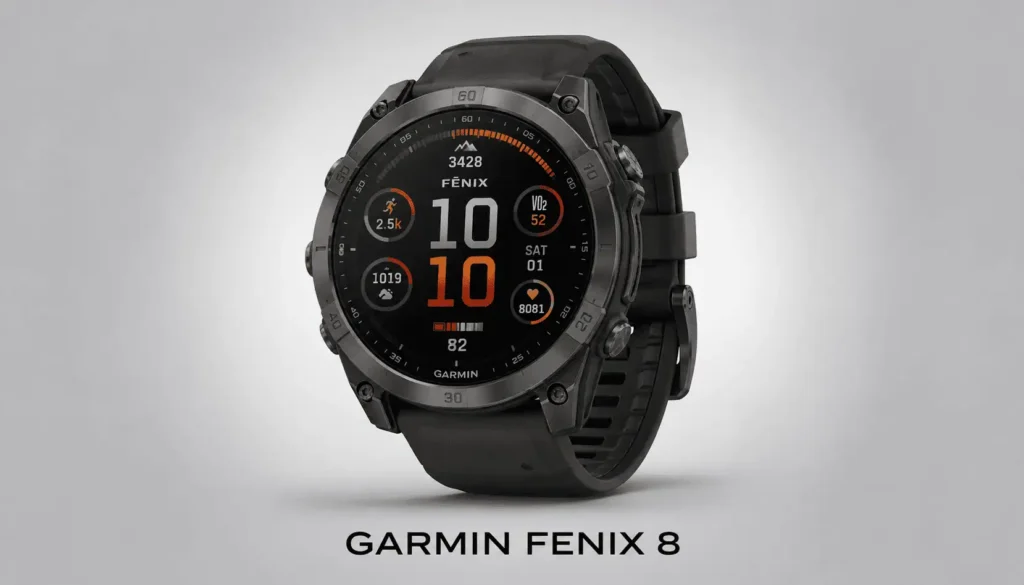
The Garmin Fenix 8 is designed for people whose workouts extend beyond a neighborhood walk. It combines multisport training, mapping, health monitoring, diving support, voice features, and long battery life inside a rugged premium case.
Garmin offers AMOLED versions in 43 mm, 47 mm, and 51 mm sizes. Solar models are available in 47 mm and 51 mm configurations, allowing buyers to choose between a brighter display and longer potential endurance.
Mission Briefing
Best for: Endurance athletes, hikers, runners, cyclists, divers, travelers, and users who value battery life more than a large third-party app ecosystem.
This review uses the 47 mm AMOLED model as the main battery benchmark. Materials, lens options, dimensions, and endurance can vary by configuration.
Choose Your Display
AMOLED
The AMOLED version offers strong color, contrast, and detailed map visibility. It is a good fit for users who want a premium smartwatch appearance without giving up advanced outdoor tools.
The 47 mm AMOLED model is rated for up to 16 days in smartwatch mode with gesture activation or up to seven days with the always-on display enabled. GPS-only estimates reach up to 47 hours with gesture activation.
Solar
Solar versions use a charging lens to extend endurance under suitable light conditions. The 47 mm solar model is rated for up to 21 days of typical smartwatch use or up to 28 days with sufficient solar exposure.
Solar performance depends on outdoor light intensity and exposure time. Buyers should view solar charging as a battery extender rather than an unlimited replacement for wired charging.
Battery Command Center
| 47 mm operating mode | AMOLED estimate |
|---|---|
| Smartwatch, gesture display | Up to 16 days |
| Smartwatch, always-on display | Up to 7 days |
| GPS only, gesture display | Up to 47 hours |
| All satellite systems | Up to 38 hours |
| Multi-band satellite mode | Up to 35 hours |
| Expedition GPS mode | Up to 17 days |
Battery estimates vary with GPS settings, music, heart-rate tracking, notifications, sensors, screen use, and environmental conditions.
Training Tools for Serious Progress
The Fenix 8 includes sport-specific profiles and advanced metrics intended to help users understand effort and recovery. Training readiness can combine recent activity and wellness information to suggest whether the body may be prepared for a demanding session.
Additional tools include endurance score, hill score, VO2 max estimates, training status, and targeted strength plans. Garmin also provides sport-specific workouts for activities such as trail running, skiing, surfing, and strength training.
Who Benefits Most?
- Marathon and ultramarathon runners
- Trail runners and hikers
- Cyclists and triathletes
- Skiers and snowboarders
- Strength-training enthusiasts
- Open-water athletes
- Scuba and apnea divers
- Travelers managing multiple activities
Casual users may never need the full depth of the training system. The Fenix 8 becomes most valuable when its maps, metrics, recovery tools, and long GPS endurance are used consistently.
Navigation Beyond Basic GPS
TopoActive maps display terrain information, while preloaded or downloadable mapping can support hiking, skiing, golf, and route planning. Dynamic round-trip routing can suggest a route based on a selected distance and adjust guidance during the activity.
The watch supports multi-satellite and multi-band positioning modes for demanding environments. These higher-accuracy settings consume more power, so users can select a mode based on the difficulty and duration of the activity.
Rugged Features That Matter
Garmin equips the Fenix 8 line with leak-resistant metal buttons and a sensor guard. The watches are tested to U.S. military standards for thermal, shock, and water resistance, while selected configurations add titanium bezels and sapphire lenses.
A built-in LED flashlight offers adjustable brightness, red light, and strobe behavior. This is useful for early runs, campsites, dark rooms, roadside visibility, and finding equipment after sunset.
Diving Support
The Fenix 8 has a 40-meter dive-rated case and supports scuba and apnea activities. Diving always requires suitable training, proper equipment, and adherence to recognized safety procedures; a smartwatch should not replace professional instruction or backup instruments.
Smart Features Without Losing the Outdoor Focus
A built-in speaker and microphone support phone calls when paired with a compatible smartphone. Certain offline voice commands can start activities, save waypoints, or create timers without requiring an active phone connection.
The watch can also provide notifications, music downloads from supported services, Garmin Pay, incident detection, LiveTrack, and Garmin Share. Some services require a compatible phone, subscription, supported bank, or network connection.
Pros and Cons
| Advantages | Trade-Offs |
|---|---|
| Excellent battery endurance | Premium purchase price |
| Detailed maps and navigation | Interface takes time to learn |
| Advanced training analysis | Larger models feel bulky |
| AMOLED and solar choices | More features than casual users need |
| Physical buttons and touchscreen | Not as app-focused as some rivals |
| Built-in flashlight | Music and GPS reduce battery life |
| Diving and voice support | Exact features vary by version |
Final Expedition Report
The Garmin Fenix 8 is not intended to be the simplest smartwatch. Its value comes from combining long battery life, navigation, serious training analysis, rugged construction, and everyday connected features.
Athletes and outdoor users can grow into its extensive toolkit over time. Buyers who only need notifications and basic step tracking will likely find a less expensive smartwatch easier to justify.